Bowers Group Bespoke Air Gauging Solutions Improve Process Capability at Reliance Precision
Posted in Technical Members News on 28th May 2026
For manufacturers operating at the forefront of precision engineering, maintaining absolute accuracy is critical at every stage of production. At Reliance Precision, advanced measurement technology plays a central role in ensuring components consistently meet the exacting standards required in industries where precision is essential.
To support this level of control, Reliance Precision partnered with Bowers Group to implement bespoke air gauging solutions across a range of demanding manufacturing applications. The systems have improved process stability, strengthened repeatability, and enhanced production accuracy for components used in sectors including defence, space, and life sciences.
Andrew Mannion, Metrology Lead at Reliance Precision, said: “The gauges have significantly improved the stability and accuracy of our measurement processes, delivering consistent and reliable results across applications. Their ease of use has enabled efficient adoption within the team, minimising training requirements and supporting day-to-day productivity.”
Manufacturing parts with complex geometries and extremely tight tolerances leaves little margin for error, particularly in mission-critical environments where reliability is essential. By integrating tailored air gauging technology into its inspection processes, Reliance Precision has strengthened quality control while maintaining the efficiency required for high-precision production.
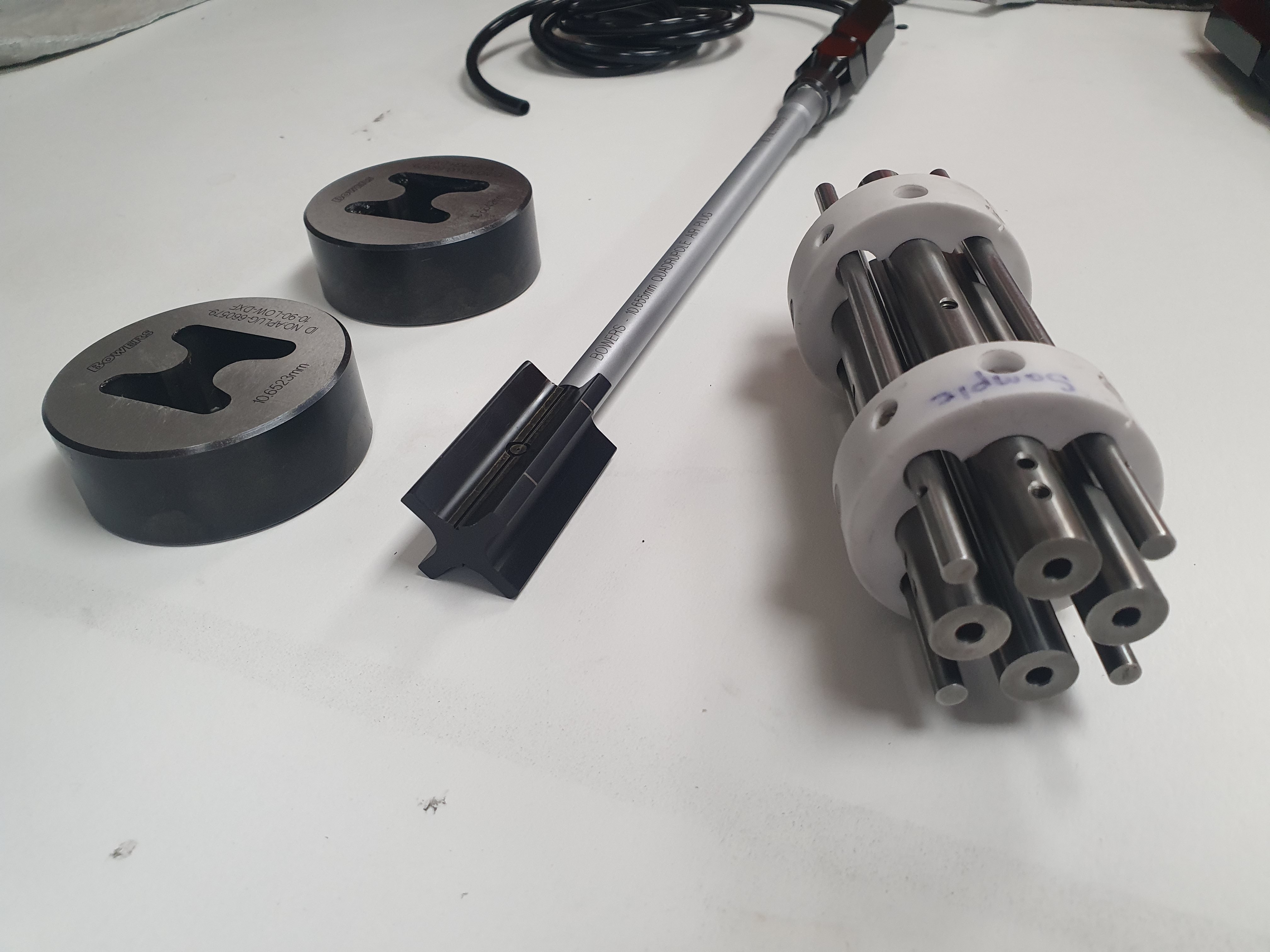
Air gauging has proven especially valuable when measuring complex internal features and tight tolerances that conventional methods struggle to verify consistently. Bowers Group and Reliance have developed bespoke air gauge solutions tailored to specific applications and geometries, ensuring the stability and repeatability needed for high-performance manufacturing.
The capability of these systems is demonstrated by the ability to verify bores with tolerances as small as 0.007mm. These measurements ensure components meet exact specifications while supporting the consistency required for continuous production.
Beyond inspection, the air gauge systems support manufacturing processes operating at the edge of current technological capability. Reliance Precision produces highly specialised electro-mechanical and opto-mechanical assemblies, precision gears, gearboxes, and advanced life science technologies such as quadrupole mass filters used in mass spectrometry. Many of these products demand exceptionally high levels of accuracy, placing significant pressure on CNC machinery, cutting tools, and measurement systems alike.
Before implementing the air gauging solutions, Reliance faced challenges around measurement stability and capability, particularly when inspecting difficult geometries. The introduction of Bowers equipment improved reliability, increased pass rates, and reduced subjectivity within the inspection process. Legacy inspection methods that relied heavily on operator interpretation have since been replaced with faster, more consistent, and repeatable measurement processes.
The systems have also been adopted quickly across multiple departments due to their ease of use and intuitive operation. While used widely throughout the business, the gauges are particularly important within turning operations and applications involving specialist components, where they help minimise training requirements while supporting productivity that maintains strict process feedback.
The relationship between Reliance Precision and Bowers Group has evolved into a long-term partnership built on technical collaboration and ongoing support. Bowers engineers regularly work alongside Reliance teams on-site to understand existing methodologies and develop tailored gauge designs suited to evolving manufacturing requirements.
Andrew explained: “Bowers Group have demonstrated a highly collaborative approach, working closely with us to develop new gauge designs that meet our specific requirements. Overall, our experience has been extremely positive, both in terms of product performance and the quality of support provided.”
This close collaboration ensures the systems remain effective for both ongoing production and new product introduction projects, where tolerances and component complexity continue to advance.
Photos

Find a BTMA Member
Scroll to zoom in on map